
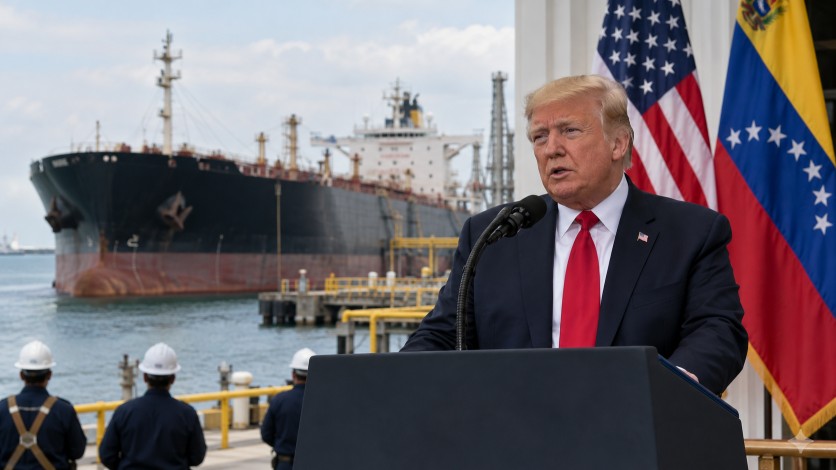
During a campaign rally in Corpus Christi, Texas, President Donald Trump highlighted a new oil deal with Venezuela as a significant achievement for American energy policy. The agreement involves the delivery of one million barrels of Venezuelan oil to the United States, a shipment Trump claimed would incur no cost to American taxpayers. He characterized the deal as one of the greatest oil victories in history, suggesting it could lead to billions of barrels of oil flowing into the country.
The arrangement follows a US military operation in January that resulted in the capture of Venezuela’s former President Nicolás Maduro, who was taken to New York to face criminal charges. The deal was negotiated with Venezuela’s interim government, and Trump hinted at the possibility of Venezuela becoming the 51st state of the United States, emphasizing the potential prosperity under the new agreement.
Trump argued that the Venezuelan oil deal would bolster US energy dominance and help alleviate rising domestic fuel prices, which have been affected by ongoing tensions with Iran and disruptions in global oil supplies, particularly through the Strait of Hormuz. This strategic maritime route is crucial as it handles about one-fifth of the world’s oil shipments, and recent disturbances have put additional pressure on energy prices.
Despite Trump’s optimistic portrayal, the agreement has attracted criticism, primarily over concerns regarding Venezuela’s political future. Critics contend that the US administration has prioritized securing Venezuelan oil access over fostering a democratic transition in the country, which has not held elections since Maduro’s capture.
The oil deal is being presented by Trump as a centerpiece of his energy strategy, but questions persist about its long-term economic effects and the likelihood of significantly reducing fuel prices in the United States. Furthermore, the issue of Venezuela’s political stability remains a contentious topic, with some arguing that the focus should also be on ensuring a democratic future for the South American nation.