
The European Union’s proposal to elevate Canada to its first associate member status is stirring diplomatic tensions, as the United States voices strong opposition to the plan. European Commission President Ursula von der Leyen extended the invitation to Canada, aiming to forge stronger ties in technology, defense, and energy amidst global challenges to the international rules-based order. This development comes as democracies are seeking closer cooperation to address shared concerns.
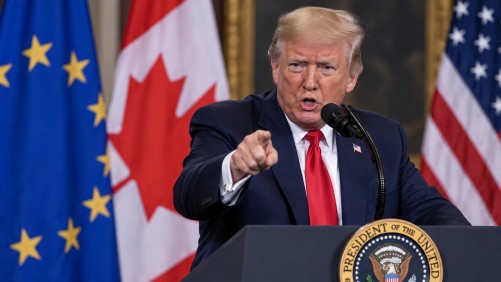
In response, U.S. President Donald Trump has publicly criticized the EU’s overture to Canada, labeling it “laughable” and suggesting it could be perceived as a “hostile act” against the United States. Trump warned that if the EU-Canada arrangement is pursued, Washington might respond with significant tariffs on European goods or reduce trade relations with the bloc. The U.S. administration’s reaction hinges on whether the EU’s intentions are deemed positive or negative.
Canada and the EU are not strangers to collaboration, having already established a trade agreement and several bilateral arrangements. Their relationship has notably intensified following the Trump administration’s decision to impose tariffs on traditional U.S. trading partners, including both Canada and the EU. With the EU seeking a deeper alliance with Canada, discussions are underway to move beyond trade and explore cooperation in various sectors such as defense industries, artificial intelligence, and cybersecurity.
Meanwhile, Canada is pursuing broader defense partnerships beyond its longstanding alliance with the United States. Ottawa has formally applied to join the British-led Joint Expeditionary Force, a rapid-response military coalition of ten NATO member states. This move signals Canada’s intent to diversify its strategic alliances in the face of evolving global security dynamics.
The specifics of what an EU associate membership for Canada would entail remain under negotiation, as the EU currently lacks a formal category for such an arrangement. However, countries like Norway, Iceland, and Switzerland maintain close economic ties with the EU, offering possible models for the proposed relationship. Von der Leyen has emphasized the EU’s desire to establish a forward-looking alliance with Canada, addressing critical areas like critical minerals, batteries, energy, and Arctic cooperation.